Rummy 91: 13-Card Rules
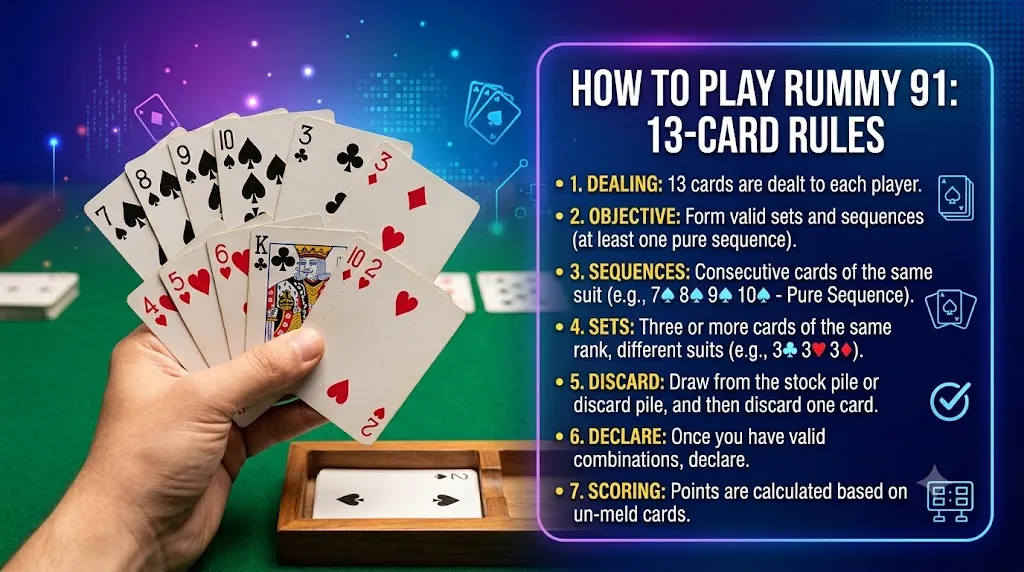
If you are new to Rummy 91 and want to understand how to play Rummy 91, the first thing to learn is the basic 13-card rummy format.
Rummy is a card game where players arrange their cards into valid combinations called sequences and sets. The objective is to arrange the cards correctly and make a valid declaration before the other players.
In this guide, we will explain Rummy 91 rules, the 13-card format, pure and impure sequences, sets, declaration, points rummy, pool rummy, and other important parts of Rummy 91 gameplay.
If you are looking for the app first, you can visit the Rummy 91 game page. If you have not installed it yet, follow our Rummy 91 APK download and installation guide before starting.
App Specs
What Is Rummy 91?
Rummy 91 is a rummy-focused gaming platform where users can play card games based on familiar Indian rummy formats.
The basic objective of 13-card rummy is to arrange the cards into valid combinations and make a correct declaration.
The most important combinations to understand are:
- Pure sequence
- Impure sequence
- Set
Understanding these three combinations makes it much easier to learn Rummy 91 gameplay.
If you want to explore similar games, you can also visit the Rummy Games collection and check other available rummy titles.
How to Play Rummy 91
The basic process of how to play Rummy 91 follows the familiar 13-card rummy structure.
A typical round works like this:
- Players receive cards.
- Players draw a card from the available options.
- They arrange their cards into sequences and sets.
- After drawing, a card is discarded.
- Players continue drawing and discarding cards.
- A player declares when their cards form valid combinations.
- The declaration is checked according to the applicable game rules.
The exact interface and game format can vary, so always check the rules displayed inside the particular Rummy 91 game.
Rummy 91 13 Card Format
The Rummy 91 13 card format means that the player works with 13 cards and attempts to arrange them into valid groups.
The cards normally need to be organized into combinations rather than simply collected based on their individual values.
For example, a player’s hand might eventually contain:
- A sequence of three or more consecutive cards from the same suit
- Another sequence
- A set of cards with the same rank
- Additional cards that can be arranged into another valid combination
The key is not simply having good individual cards. The objective is to create a valid overall arrangement.
Understanding Rummy 91 Sequences
A sequence consists of consecutive cards arranged according to the applicable rummy rules.
There are two important types:
- Pure sequence
- Impure sequence
Understanding the difference is essential before making a declaration.
What Is a Rummy 91 Pure Sequence?
A Rummy 91 pure sequence is a sequence of consecutive cards from the same suit without using a joker as a substitute.
For example:
5♥ – 6♥ – 7♥
These cards are consecutive and belong to the same suit, making them an example of a pure sequence.
Another example:
10♣ – J♣ – Q♣ – K♣
The cards are consecutive and belong to the same suit.
A pure sequence is one of the most important combinations to understand in 13-card rummy.
Why Is a Pure Sequence Important?
In standard Indian 13-card rummy formats, a valid declaration generally requires at least one pure sequence.
That means you should not focus only on collecting high-value cards. Building a valid sequence should usually be one of your first priorities.
What Is a Rummy 91 Impure Sequence?
A Rummy 91 impure sequence is a sequence where a joker is used to represent a missing card.
For example:
5♥ – 6♥ – Joker – 8♥
If the joker represents the 7♥, the cards form an impure sequence.
The important difference is:
Pure sequence: consecutive cards of the same suit without a substitute joker.
Impure sequence: a valid sequence where a joker substitutes for a missing card.
Always check the specific game rules for how jokers are treated.
What Are Rummy 91 Sets?
A Rummy 91 set consists of cards with the same rank but different suits.
For example:
8♥ – 8♣ – 8♦
These cards have the same value but different suits, so they form a set.
Another example could be:
K♥ – K♣ – K♠
The exact combination rules can depend on the game format, but the basic concept is matching the same rank across different suits.
Sequence vs Set
It is useful to remember the difference:
| Combination | Basic idea | Example |
|---|---|---|
| Pure sequence | Consecutive cards, same suit, no joker substitute | 4♥ 5♥ 6♥ |
| Impure sequence | Consecutive cards using a joker | 4♥ 5♥ Joker 7♥ |
| Set | Same rank, different suits | 9♥ 9♣ 9♦ |
Once you understand these three combinations, the rest of the game becomes easier to follow.
How a Rummy 91 Turn Works
During a typical rummy turn, the player has two main actions:
Draw a Card
The player selects a card from an available draw pile or discard pile according to the game interface.
The new card can be used to improve an existing sequence or set.
Discard a Card
After selecting a card, the player normally discards one card.
This keeps the hand organized and helps the player move closer to a valid declaration.
Example
Suppose you have:
4♥ – 5♥ – 8♣ – 8♦ – 9♠
You may be looking for:
- 6♥ or 7♥ to improve a sequence
- Another 8 of a suitable suit to complete a set
The decisions you make after every draw and discard are an important part of Rummy 91 gameplay.
How to Arrange 13 Cards in Rummy 91
Card arrangement is one of the most important skills for beginners.
Instead of looking at all 13 cards as one large group, separate them into possible combinations.
For example:
Group 1: 3♥ 4♥ 5♥
Group 2: 8♣ 8♦ 8♠
Group 3: 10♠ J♠ Q♠
Group 4: K♥
The final unmatched card needs to be incorporated into a valid combination before a declaration.
Try to identify:
- Cards already forming sequences
- Cards that can form sets
- Cards that can complete a sequence
- High-value cards that are not helping your combinations
What Is a Rummy 91 Declaration?
A Rummy 91 declaration is the action of submitting your arranged cards when you believe your hand meets the required conditions.
This is an important moment because declaring with an invalid combination can result in the hand being treated as incorrect.
Before declaring, check your cards carefully.
Declaration Checklist
Before pressing the declaration button, check:
- Do you have the required pure sequence?
- Are your other groups valid?
- Are all 13 cards arranged?
- Are any cards left ungrouped?
- Are your jokers being used correctly?
- Does your arrangement follow the current game rules?
Taking a few seconds to check your hand can prevent an avoidable invalid declaration.
Rummy 91 Points Rummy
Rummy 91 points rummy refers to a points-based rummy format where the value of cards is important when calculating the result.
In a typical points-based rummy format:
- Number cards generally carry their face value.
- A, K, Q and J have specific values according to the applicable rules.
- Jokers generally carry zero points when used appropriately.
- The objective is to arrange your cards into valid combinations and minimize the points left outside valid combinations.
The exact scoring system should always be checked inside the current Rummy 91 game before playing.
Example of Points
Suppose a player has an unmatched:
K♥
If that card is not included in a valid combination, its value can contribute significantly to the player’s points.
This is why high-value cards that cannot be arranged should not be kept unnecessarily.
Rummy 91 Pool Rummy
Rummy 91 pool rummy is a different format from points rummy.
In pool-style rummy, players generally continue playing across rounds, and accumulated points determine when a player is eliminated or how the overall result is calculated.
Common pool formats can include different point limits, depending on the game.
For example, you may encounter formats based around different point thresholds.
However, the exact format available in Rummy 91 should be checked inside the current game interface because platforms can offer different variations.
Points Rummy vs Pool Rummy
The basic difference can be understood like this:
| Feature | Points Rummy | Pool Rummy |
|---|---|---|
| Game structure | Usually played as individual rounds | Can continue across multiple rounds |
| Scoring | Points calculated for the hand | Points accumulate across rounds |
| Main objective | Complete a valid hand efficiently | Avoid reaching the applicable elimination limit |
| Format | Faster round-based gameplay | Longer session structure |
The exact rules can vary between platforms.
How Jokers Work in Rummy 91
Jokers are important in many 13-card rummy formats.
A joker can often help complete an impure sequence or set by replacing a missing card.
For example:
7♣ – 8♣ – Joker – 10♣
The joker can represent the missing 9♣.
However, a joker does not replace the need to create the required pure sequence.
This is why beginners should avoid relying entirely on jokers.
Tips for Understanding Rummy 91 Gameplay
If you are new to the game, focus on the basic principles rather than trying complicated strategies immediately.
1. Build a Pure Sequence Early
A pure sequence is an important requirement in standard 13-card rummy.
Look for consecutive cards from the same suit as soon as you receive your hand.
2. Keep Related Cards Together
Group cards mentally or within the game’s sorting system.
For example:
5♥ 6♥ 7♥
is much more useful together than treating each card separately.
3. Do Not Hold Unnecessary High Cards
High-value cards can increase your points if they remain unmatched.
If a K, Q, or J does not help your combinations, consider whether keeping it makes sense.
4. Watch the Discard Pile
The cards another player discards can provide clues about what they may not need.
However, do not assume you know their complete strategy based on one discard.
5. Use Jokers Carefully
A joker can help complete an impure combination, but it should not distract you from building the required pure sequence.
6. Check Your Hand Before Declaration
Never rush the declaration.
Check every group before submitting.
Common Beginner Mistakes in Rummy 91
Trying to Make Only Sets
Sets are useful, but focusing only on sets can leave you without the required sequence structure.
Ignoring Pure Sequences
One of the biggest beginner mistakes is waiting too long to build a pure sequence.
Holding High Cards Too Long
Unmatched high-value cards can increase your points.
Declaring Too Quickly
A hand that looks complete may still contain an invalid group.
Always check the arrangement before declaring.
Depending Too Much on Jokers
Jokers are useful, but they cannot replace every requirement.
Rummy 91 Gameplay Example
Consider a simplified 13-card hand:
3♥ 4♥ 5♥
7♣ 8♣ Joker 10♣
Q♦ Q♠ Q♥
2♠ 3♠
Here:
- 3♥ 4♥ 5♥ = pure sequence
- 7♣ 8♣ Joker 10♣ = possible impure sequence if the joker represents 9♣
- Q♦ Q♠ Q♥ = set
- 2♠ 3♠ = incomplete sequence
The final two cards still need to be arranged into a valid combination before a declaration.
This example shows why simply having several good groups is not enough. The entire 13-card hand must satisfy the applicable declaration rules.
Rummy 91 and Other Rummy Games
If you enjoy 13-card rummy, there are several related games available on the site.
You can explore Yono Rummy, Gold Rummy, Gogo Rummy, Top Rummy, and ABC Rummy.
You can also browse the broader Yono Games collection to compare other available titles.
For Yono Rummy specifically, our Yono Rummy Complete Guide covers additional information beyond the basic gameplay rules.
Rummy 91 Download and Installation
If you have not installed Rummy 91 yet, you can start from the Rummy 91 game page.
For the complete Android installation process, read:
How to Download and Install Rummy 91 APK on Android
That guide covers APK downloading, Android installation permissions, common installation errors, and basic troubleshooting.
Rummy 91 Login and Account Verification
After installing the application, you may need to register or log in before accessing the game.
Our Yono Games Login & Registration Guide explains the general account process.
If the platform asks you to verify your account, you can also read our Yono Games Account Verification Guide for information about OTP verification, account checks, and common verification problems.
Rummy 91 Bonus and Withdrawal
If you are exploring promotional offers associated with Rummy 91, check the current terms before claiming anything.
You may come across welcome or promotional offers, but bonuses should not be treated as guaranteed cash. Eligibility and conditions can vary.
Our Yono Games Bonus Guide explains common bonus and promotional terms.
If you use a referral offer, see the Yono Games Referral Code Guide.
For payment-related information, read the Yono Games Withdrawal Guide and check the current rules displayed by the specific platform.
Frequently Asked Questions
How do I play Rummy 91?
To play Rummy 91, arrange your cards into valid sequences and sets, draw and discard cards during your turns, and make a valid declaration when your complete hand satisfies the applicable rules.
What are the basic Rummy 91 rules?
The basic rules involve arranging cards into valid sequences and sets. In a standard 13-card format, a valid hand generally requires at least one pure sequence along with valid remaining combinations.
What is Rummy 91 13 card rummy?
It is a 13-card format where players arrange 13 cards into sequences and sets and attempt to make a valid declaration.
What is a Rummy 91 pure sequence?
A pure sequence consists of consecutive cards of the same suit without using a joker as a substitute.
Example: 5♥ 6♥ 7♥.
What is a Rummy 91 impure sequence?
An impure sequence is a valid sequence that uses a joker as a substitute for a missing card.
What is a Rummy 91 set?
A set consists of cards with the same rank from different suits.
Example: 8♥ 8♣ 8♦.
What is a Rummy 91 declaration?
A declaration is the action of submitting your arranged cards when you believe they satisfy the applicable winning or valid-hand conditions.
What is Rummy 91 points rummy?
Points rummy is a format where the result is calculated using card points according to the applicable scoring rules.
What is Rummy 91 pool rummy?
Pool rummy is a format where players can continue across rounds and accumulated points are used according to the applicable pool rules.
Do I need a pure sequence to declare?
In standard 13-card Indian rummy formats, a pure sequence is generally a mandatory part of a valid declaration. Always check the current Rummy 91 rules displayed inside the game.
Can a joker be used in a pure sequence?
A joker used as a substitute normally makes the sequence impure rather than pure. A pure sequence generally does not use a substitute joker.
Final Words
Learning how to play Rummy 91 becomes much easier once you understand the basic 13-card structure.
Focus first on the three core combinations:
Pure sequence → Impure sequence → Set
Then learn how drawing, discarding, jokers, points, and declaration work together.
Before declaring, always check the entire hand rather than assuming that a few completed groups are enough. The exact Rummy 91 interface and available formats can change, so use the current rules displayed inside the platform as the final reference.
If you are ready to explore the game, visit the Rummy 91 page. For installation help, use the Rummy 91 APK download and installation guide.
You can also explore Yono Rummy, Gold Rummy, Gogo Rummy, Top Rummy, and the wider Rummy Games collection.
For more guides about downloads, login, bonuses, verification, referrals, and withdrawals, visit the Yono Games Blog.